 Annual Leave Tracker
UK Statutory Sick Pay Requirements Explained
Statutory Sick Pay, or SSP, is the legal minimum that UK employers have to pay eligible employees when they're off sick. It’s not an optional perk; it's a legal requirement that provides a basic financial safety net for people who are too ill to work.
For an employee to qualify, they need to tick a few specific boxes related to their job and how much they earn.
What Are the Core Statutory Sick Pay Requirements
Trying to get your head around Statutory Sick Pay (SSP) can feel a bit like wading through legal jargon, but the core idea is pretty straightforward. Think of it as the absolute baseline for sick pay in the UK. Every employer must follow these rules for any employee who qualifies. It's a legal duty, not a discretionary bonus, put in place to ensure people have some income when they're medically unable to work.
The whole system is built on a clear framework that dictates who is eligible, what they get paid, and for how long. To get SSP, a person has to be officially classed as an employee, have actually started their job, and earn more than a specific amount each week. If they meet these criteria, their employer is legally bound to pay them the standard weekly SSP rate for up to 28 weeks.
Key SSP Rules in Practice
Meeting the statutory sick pay requirements isn't as simple as an employee just calling in sick. It's about satisfying a specific checklist of legal conditions.
These are the fundamental pillars of the SSP system:
- Employment Status: The individual must legally be an 'employee' with an employment contract. This also covers agency workers.
- Earnings Threshold: On average, their earnings must be at least the Lower Earnings Limit (LEL) for National Insurance. For the 2024/25 tax year, that figure is £123 per week.
- Period of Incapacity for Work (PIW): The employee must be off sick for at least four days in a row. This includes weekends and any other non-working days, and it's officially known as a PIW.
- Correct Notification: They need to tell their employer they're sick within the company's specified deadline (or within seven days if the company doesn't have one).
To make these rules easier to digest, here’s a quick summary of the essentials.
Statutory Sick Pay Requirements at a Glance
The table below breaks down the key rules and rates for SSP, giving you a clear, at-a-glance reference.
| Requirement | Details |
|---|---|
| Eligibility | Must be an employee earning at least £123 per week on average. |
| Current Rate (2024/25) | The standard weekly payment is £116.75. |
| Payment Duration | SSP is payable for a maximum of 28 weeks for a single or linked period of sickness. |
| Waiting Days | SSP is not usually paid for the first three qualifying days of sickness (these are 'waiting days'). |
| Proof of Sickness | Employees must self-certify for the first 7 days, then provide a 'fit note' from a doctor. |
It's a handy cheat sheet for understanding the core obligations at the heart of the SSP system.
Important Note: Remember, SSP is just the legal minimum. Many companies offer their own, more generous contractual sick pay schemes. However, these company policies can never pay less than the statutory amount for employees who are eligible.
Who Qualifies for Statutory Sick Pay
It’s a common misconception that if an employee calls in sick, they automatically get paid for it. In reality, qualifying for Statutory Sick Pay (SSP) involves ticking a few specific boxes set out by the government.
Think of it as a checklist. Before any SSP is paid, you and your employee need to confirm that all the statutory sick pay requirements have been met. This isn't just red tape; it's a system designed to ensure fairness and consistency for every business in the UK. Getting these details right from the start is key to staying compliant and avoiding any potential disputes.
Let’s walk through the essential criteria, one by one.
The Employee Status Test
First off, the person has to be legally considered an 'employee'. This means they work for you under a contract of employment, which forms the basis of your legal obligations. It’s not just about your permanent, full-time team, either.
The net is cast pretty wide and includes:
- Part-time workers: They have the exact same rights to SSP as their full-time colleagues, as long as they meet the other conditions.
- Fixed-term or temporary staff: Their rights are protected for the duration of their contract.
- Agency workers: They also qualify, provided they have a contract with and are paid via the agency's payroll.
The crucial element here is the employment contract. If one exists, you have a duty to consider that individual for SSP.
Meeting the Minimum Earnings Threshold
Just being on the books isn't quite enough. An employee also needs to earn a certain amount to be eligible. The benchmark for this is the Lower Earnings Limit (LEL) for National Insurance contributions, which the government reviews each tax year.
For the 2024/2025 tax year, the magic number is an average weekly earning of at least £123 before tax. This is usually calculated based on their pay in the eight weeks leading up to their sickness.
This is where things can get a bit tricky, especially for staff on zero-hours contracts or with fluctuating hours. Their eligibility can literally change from one month to the next, depending on the work they've had. It’s a frequent source of confusion, so meticulous payroll calculations are essential.
An employee might qualify for SSP after a busy Christmas period but then fall below the threshold during a quiet January. This shows why you have to assess eligibility for each separate period of sickness based on their recent earnings.
The Period of Incapacity for Work
To trigger SSP, an employee needs to be off sick for a solid block of time. The official term for this is a 'Period of Incapacity for Work' (PIW), and it’s defined as being sick for four or more days in a row.
These four days are consecutive and include any non-working days. So, if someone is unwell from Friday through to Monday, that counts as a four-day PIW, even though they wouldn't have worked on Saturday and Sunday.
It’s this four-day stretch that gets the SSP ball rolling. Any absence shorter than that simply doesn't qualify for statutory pay. It's also worth remembering the 'waiting days' rule—the first three days of a PIW are qualifying days but are typically unpaid under the SSP scheme.
Keeping a precise record of these absence dates is non-negotiable for payroll accuracy and legal compliance. For many small businesses, ditching spreadsheets for specialised software makes this far less of a headache. To explore how technology can streamline this, have a look at our complete guide on HR systems for small business management. It can automate the tracking and help you meet your obligations without drowning in admin.
How SSP Is Calculated and Paid
When a team member is off sick, their focus should be on getting better. But let’s be realistic—worrying about money can get in the way of recovery. That’s why getting a handle on how Statutory Sick Pay (SSP) is calculated and paid is so important for everyone involved. It removes the guesswork and helps both sides plan accordingly.
The financial side of SSP isn't just about a single weekly figure. It’s about understanding payment schedules, what gets deducted, and how long an employee can receive it. Getting these details right is fundamental to meeting your legal duties and, just as importantly, maintaining a relationship of trust with your staff.
The Current SSP Rate and Payment Duration
For the 2024/25 tax year, the standard weekly rate for SSP is £116.75. But it's not quite as simple as just paying that flat amount. SSP is actually worked out on a daily basis for the days an employee would normally have worked, which are known as 'qualifying days'.
As an employer, you're required to pay SSP for a maximum of 28 weeks for a single period of sickness (or for linked periods). Once an employee hits that 28-week limit, your obligation to pay SSP ends. At that point, they might need to look into other forms of government support, like the Employment and Support Allowance (ESA).
A Major Shift in How SSP is Calculated
The way SSP works in the UK is about to change significantly. For years, the flat-rate system has been criticised because it often means a huge drop in income for lower-paid workers when they fall ill. New reforms, slated for 2025, are designed to tackle this problem head-on.
These aren't just minor tweaks; they represent a fundamental shift. The new system will pay the higher of either 80% of an employee’s normal weekly earnings or a new flat rate of £118.75, capped at the employee's regular earnings. This makes SSP a much more realistic safety net for those on lower incomes. The reforms also get rid of the three-day ‘waiting period’, so employees will qualify for SSP from their very first day of sickness. On top of that, the government is scrapping the Lower Earnings Limit, a rule that has historically shut out many low-paid and gig-economy workers from getting any sick pay at all. It's a good idea to get ahead of these changes by reviewing the government's official statutory sick pay guidance.
This is a real game-changer, especially for the part-time and flexible workers who make up so much of the modern workforce.
Before and After Example: Think about a part-time employee who earns £140 a week. Under the current system, they’d get the flat rate of £116.75. But under the new 2025 rules, their SSP would be calculated as 80% of their earnings (£112), giving them a payment that's much more in line with their usual take-home pay.
How SSP Payments Are Made
Paying SSP shouldn't feel like a separate, clunky process. In fact, it's designed to be handled directly through your normal payroll run. This means the employee receives it on their usual payday, whether that’s weekly or monthly, providing a sense of consistency.
And just like their regular wages, SSP payments are subject to the usual deductions. This includes:
- Income Tax: PAYE is applied to SSP just as it would be to their normal salary.
- National Insurance Contributions: Both employee and employer contributions are deducted as standard.
- Other Deductions: If they have other regular deductions, like student loan repayments or pension contributions, these will also come out of the SSP payment.
In short, you treat SSP as part of the employee's gross pay for that pay period. This keeps their tax and National Insurance records straight and ensures they continue to build up their state pension entitlement, even while they're unable to work. It’s a simple integration that makes administration far easier for you and provides stability for your employee during a difficult time.
Understanding Your Duties as an Employer
Getting Statutory Sick Pay (SSP) right isn't just good practice—it's a legal duty. For many businesses, the rules can seem a bit tangled, but once you break them down, they're perfectly manageable. It’s all about having a clear process.
Your responsibilities kick in the second an employee tells you they’re too ill to work. From there, you need to assess their eligibility, calculate what they're owed, and keep everything properly documented. This shows you’re treating your staff fairly and legally, especially when they’re feeling vulnerable.
Getting this wrong can lead to messy employee disputes, financial penalties, and a hit to your company's reputation. Let's walk through exactly what you need to do.
Managing Waiting Days and Payments
One of the cornerstone rules of SSP used to be the 'waiting days' period. In the past, you didn't pay an employee for the first three days they were off sick. SSP only started from the fourth day.
However, a major change has scrapped this rule. Eligible employees are now entitled to receive SSP from the very first day they are off sick. This makes things much simpler and ensures people, especially those on lower incomes, aren't left out of pocket for short illnesses.
Your main job is to pay SSP on the employee's usual payday, right alongside their normal wages. It goes through your standard payroll system and is subject to the same PAYE tax and National Insurance deductions. Running it smoothly keeps you compliant and maintains trust with your team.
The Importance of Meticulous Record Keeping
When it comes to SSP, you have to keep good records. It's not optional. The law requires you to keep a detailed log of each employee’s sickness absence, and shoddy paperwork is a fast track to compliance problems.
Make sure your records include:
- Dates of Sickness: The exact start and end dates for every single period of absence.
- SSP Payments: A clear breakdown of all SSP you've paid out, showing which dates the payments cover.
- Linked Periods: A note of any sickness periods that are 'linked'—that is, absences of 4 or more days that happen within 8 weeks of each other.
You must hold onto these records for at least three years after the end of the tax year they relate to. Ditching the spreadsheet for a dedicated tool can make a world of difference. Modern staff absence management software can automate much of this, keeping your records accurate and ready for any inspection.
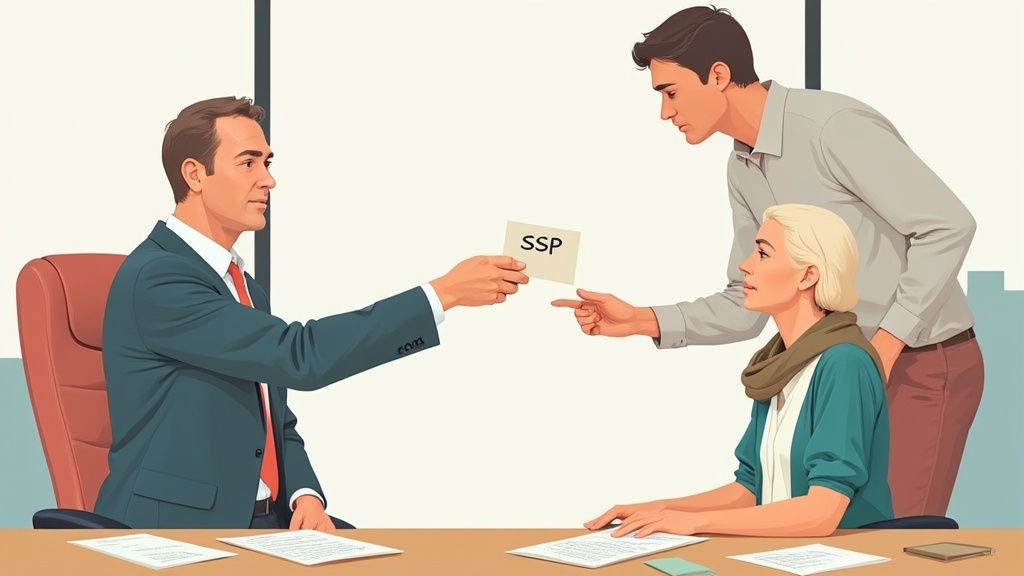
Issuing Form SSP1 When Necessary
Sometimes, an employee won't be eligible for SSP, or their entitlement will run out. When this happens, you have a legal duty to give them a specific form to explain why.
This is where Form SSP1 comes into play. You must give this to an employee if:
- They don’t qualify for SSP from the start (perhaps their earnings are below the Lower Earnings Limit).
- Their SSP is about to stop because they've reached the 28-week maximum.
You have to provide Form SSP1 within seven days of their sickness ending (if their SSP is running out), or within seven days of them telling you they're sick (if they never qualified in the first place).
This form is incredibly important. It’s the official document your employee needs to apply for other state benefits, like Employment and Support Allowance (ESA). Failing to issue it on time can cause serious delays in them getting financial help, which is the last thing anyone needs when they're unwell. It’s a crucial part of being a responsible employer.
A Look Back at UK Sick Pay: How We Got Here
To really get to grips with today's sick pay rules, it helps to understand where they came from. The system we have now wasn't created in a day; it’s the result of decades of tweaks and changes, all aimed at building a better safety net for people who fall ill. This journey explains the "why" behind the current laws and the move towards a system that actually works for a modern workforce.
Statutory Sick Pay (SSP) first appeared on the scene back in 1983. The idea was simple: create a standard, minimum amount of money an employee should get when they're too unwell to work. But the first version was pretty basic and has been updated countless times since to keep up with the economy and changing ideas about employee wellbeing.
From a Flat Rate to a Fairer System
For a long time, SSP was just a simple, one-size-fits-all flat rate. It was easy to administer, but it often left workers short, especially those on lower wages or in less traditional jobs.
The rate has been adjusted over the years to try and keep pace. For the 2025/26 tax year, the standard weekly rate is £118.75, a small increase from £116.75 the year before. But unlike many European countries that link sick pay to earnings, the UK’s flat-rate model meant higher earners saw a massive income drop when they were off sick. This approach came under fire during major health crises, with many pointing out that the rate simply wasn't enough to live on. You can see how the rates have changed over the years in these UK sick pay rate trends on Statista.com.
Fixing the Gaps in the System
Two of the biggest historical problems with SSP were the 'three waiting days' rule and the Lower Earnings Limit (LEL). Both of these created real hardship and, frankly, excluded the very people who needed the support most.
- The Three Waiting Days: For years, SSP only kicked in from the fourth day of sickness. If you were off for three days or less, you got nothing. For anyone living paycheque to paycheque, this created a horrible choice: go to work sick or lose money you couldn't afford to lose.
- The Lower Earnings Limit: To even qualify for SSP, you had to earn over a certain amount each week. This seemed logical on the surface, but it meant that a huge number of part-time, casual, and zero-hours contract workers had no legal right to any sick pay.
These old rules exposed a major flaw in the UK's welfare safety net. The recent reforms that scrapped these requirements are a huge step forward, creating a much more inclusive system for all employees, no matter their income or how they work.
Knowing this history gives you the context for the statutory sick pay requirements we have today. These aren't just administrative changes; they represent a real shift in policy to make sick pay fairer and more relevant. By understanding how the system has evolved, you can better appreciate why it's so important to apply the current rules correctly.
Untangling the Trickier Side of SSP
Sickness absence is rarely straightforward. While the basic rules of Statutory Sick Pay cover most situations, what happens when things get a bit more complex? This is where many managers and business owners start to feel out of their depth, dealing with scenarios that don't have simple, clear-cut answers.
Getting to grips with how SSP works in these grey areas is crucial. It’s not just about compliance; it's about treating your employees fairly and consistently. Whether it’s sickness during a holiday or a recurring health problem, understanding your obligations protects both your business and your team.
This quick visual breaks down the three key numbers that are the foundation of every SSP calculation.
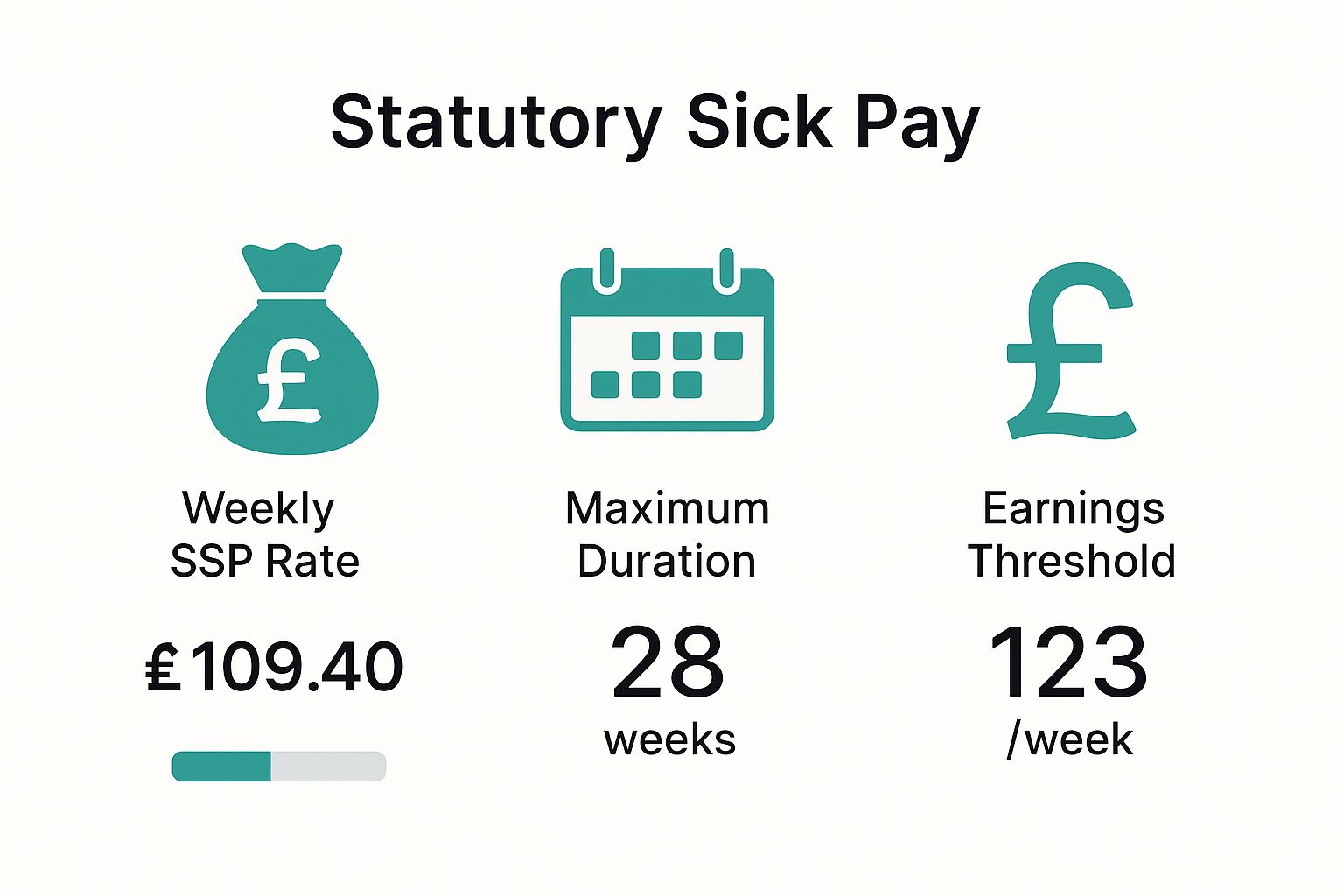
Think of these three figures – the weekly payment, the earnings threshold, and the 28-week limit – as your core building blocks. Once you have these down, you can confidently handle almost any absence scenario that comes your way.
Sickness During Annual Leave or a Notice Period
One of the most frequent questions we hear is: what if an employee gets sick while on holiday? It’s simple, really. If they fall ill during pre-booked annual leave, they have the right to take that time as sick leave instead. They can then reclaim those holiday days to use later.
Of course, they’re only entitled to SSP for those days if they meet all the usual criteria and follow your company's sickness reporting process.
The same logic applies when someone is working their notice. An employee who is off sick during their notice period is still entitled to SSP, as long as they qualify. Their employment contract is still active until their last day, which means their statutory rights are too.
How Linked Periods of Sickness Work
Sometimes an employee might have several spells of absence for the same or a related illness. HMRC has a specific rule for this called 'linked periods of sickness', and it’s a big one to get right.
Two periods of sickness are considered 'linked' if:
- Each absence lasts for four or more days in a row.
- The gap between them is 56 days (8 weeks) or less.
When periods are linked, you treat them as a single, continuous absence for SSP purposes. This has a couple of important implications. First, the employee doesn't have to go through the three unpaid 'waiting days' for the second or any subsequent linked absences. More critically, all the days from these linked periods count towards their 28-week maximum SSP allowance. This is why accurate record-keeping is non-negotiable.
For example: If an employee is off for two weeks in June with a back problem and then needs another three weeks off in July for the same issue, these periods are linked. The 28-week SSP clock that started ticking in June keeps running through the July absence.
Handling Disputes and Fit Notes
What if you have doubts about an employee's sickness claim? This can be a tricky situation. You are legally obligated to pay SSP if they meet the criteria, but that doesn't mean you can't ask for more information. If you suspect an absence isn't genuine, it needs to be addressed through your formal disciplinary procedure, not by simply withholding their statutory pay.
After seven calendar days of sickness, a fit note (officially a 'Statement of Fitness for Work') from a healthcare professional is the standard evidence you'll need. This note might say an employee is 'not fit for work,' or it could suggest they 'may be fit for work' with some adjustments.
If the fit note recommends changes—like different hours, amended duties, or working from home—you have a duty to discuss these with your employee and try to accommodate them. Ignoring these recommendations isn't just unhelpful; it could lead to a longer absence and potentially even a disability discrimination claim down the line.
Navigating these specific employment situations can be challenging, as the standard rules often need careful interpretation. Here's a quick-glance table to help clarify how SSP applies in some common but complex scenarios.
How SSP Applies in Different Employment Scenarios
| Scenario | SSP Application and Key Considerations |
|---|---|
| Zero-Hours Contract | Workers are eligible for SSP if they meet the earnings threshold (£123 per week) and have done some work under their contract. You must assess their average weekly earnings over the 8 weeks prior to their sickness. |
| Pregnancy-Related Sickness | An employee is entitled to SSP for a pregnancy-related illness right up until the day before her maternity leave starts or the baby is born. If the illness occurs in the 4 weeks before the due date, it may trigger her Statutory Maternity Pay (SMP) to start automatically. |
| Fixed-Term Contract | Employees on fixed-term contracts have the same SSP rights as permanent staff. Their entitlement ends when their contract ends, even if they are still sick. |
| Agency Workers | Agency workers are entitled to SSP from their agency if they meet the eligibility criteria. They must inform the agency of their sickness, not just the company where they are placed. |
| Multiple Jobs | An employee can claim SSP from multiple employers if they earn above the Lower Earnings Limit in each job. Their sickness absence in one job doesn't automatically mean they are sick for the other; it depends on the nature of the illness and the work. |
Understanding these nuances is key to ensuring fair treatment for all employees, regardless of their contract type or personal circumstances, while keeping your business compliant.
Common Questions About Statutory Sick Pay
When it comes to Statutory Sick Pay (SSP), it’s natural for specific, real-world questions to pop up. To help clear things up, we’ve put together some straightforward answers to the queries we hear most often from employers and their staff.
Think of this as your quick-reference guide for those tricky "what if" scenarios. Getting a handle on these details is key to making sure everyone is treated fairly and everything stays above board.
Can an Employer Refuse to Pay SSP?
In short, no. If an employee meets all the statutory sick pay requirements, an employer is legally bound to pay it. This isn't a discretionary benefit; it's the law.
Should an employer wrongly refuse to pay SSP, the employee has the right to contact HM Revenue and Customs (HMRC). HMRC can then step in, investigate the claim, and force the employer to pay what's owed. Trying to dodge this obligation can result in some hefty penalties.
What Proof of Sickness Is Required?
The type of proof you need really depends on how long your team member is off sick. It’s a simple two-stage process.
- For the first 7 days: An employee can simply 'self-certify' that they're too ill to work. No doctor's note is required for this initial week.
- After 7 days: If the absence stretches beyond seven consecutive days (and that includes weekends), the employee must provide a 'fit note' from a doctor or another registered healthcare professional.
It's important to remember that you can't insist on a fit note for an absence of seven days or less. What you can do is ask the employee to fill out a company self-certification form to keep the records straight for everyone.
What Happens When SSP Ends?
SSP provides a safety net, but it has its limits. It can be paid for a maximum of 28 weeks. After that, the employer's duty to pay SSP comes to an end.
Before the payments stop, it's vital that the employer gives the employee form SSP1. This official form is the key that unlocks other government support, like the Employment and Support Allowance (ESA), which can offer financial help during a longer-term illness.
Does SSP Apply to Zero-Hours Contracts?
Yes, it absolutely does. Workers on zero-hours contracts are eligible for SSP, as long as they tick the right boxes. The main hurdles are that they must have actually performed some work under their contract and earned an average of at least the Lower Earnings Limit, which is £123 per week for the 2024/25 tax year.
Working out their average earnings can be a bit fiddly, but getting it right is crucial. It ensures that people with less predictable work patterns still get the support they're legally entitled to. It's also worth noting that sick pay and holiday rights are two different things; you can read our complete employee guide to UK holiday entitlement for more on that.
Juggling SSP, holidays, and other absences can feel like a headache. Annual Leave Tracker brings it all together in one clear, simple system. It helps you track all types of leave, so you can stay organised and compliant without the stress. Find out more at Annual Leave Tracker.
Ready to Transform Your Leave Management?
Join 500+ companies using Annual Leave Tracker to streamline their HR processes.
Related Articles

How to Calculate Pro Rata Holidays A Simple UK Guide
Working out pro rata holidays is actually quite straightforward. At its core, it's just about making...
September 24, 2025
How to Calculate Annual Leave Entitlement: UK Guide
Figuring out annual leave entitlement doesn't have to be complicated. The basic formula is simple:...
September 24, 2025
HR Systems for Small Business A Complete Guide
Trying to run a small business using spreadsheets and a jumble of different documents is a bit like...
September 25, 2025