 Annual Leave Tracker
UK Maternity Leave Calculator Guide

Figuring out maternity pay can feel like a maze, but a good maternity leave calculator is a fantastic starting point. It essentially does the heavy lifting for you, estimating your statutory pay based on your salary and when you plan to start your leave.
The tool will typically map out your pay for the first 6 weeks (which is 90% of your average earnings) and then the following 33 weeks at the standard government rate. This gives you a clear financial forecast for your time off.
Understanding Your UK Maternity Leave Entitlements
Before you jump into a calculator, it’s really helpful to get your head around what you’re legally entitled to in the UK. Many people don't realise that your right to take the leave and your right to get paid for it are two separate things.
Statutory maternity leave is a day-one right, meaning you're entitled to it from your first day on the job. Pay, however, depends on how long you've been with your employer. It’s best to think of your leave as a 52-week package, split into two distinct halves.
The Two Phases of Maternity Leave
Your full year of leave is broken down into two 26-week periods. Knowing the difference between them is crucial, as it affects your rights when you decide to return to work.
-
Ordinary Maternity Leave (OML): This covers the first 26 weeks. During this time, all your employment rights are fully protected. Crucially, you have the right to return to your exact same job—same role, same seniority, same everything.
-
Additional Maternity Leave (AML): This is the second 26 weeks. Your employment is still protected, but things are slightly different. If you take AML, your employer can offer you a suitable alternative role if your original job no longer exists. It has to be on the same terms and conditions, but it might not be the exact same position.
Here's a quick summary to keep things simple:
UK Maternity Leave At a Glance
The table below breaks down the core components of the UK's statutory maternity leave system, providing a clear overview of what you can expect during each phase.
| Component | Duration | Key Features |
|---|---|---|
| Ordinary Maternity Leave | First 26 weeks | All employment rights are protected. You have the legal right to return to your exact same job. |
| Additional Maternity Leave | Next 26 weeks | Employment is still protected. You can be offered a suitable alternative role if your original job isn't available. |
| Total Statutory Leave | 52 weeks | The combined total leave you are entitled to take. You don't have to take it all. |
| Statutory Maternity Pay | Up to 39 weeks | Paid for the first 39 weeks if you meet the eligibility criteria (continuous employment and earnings). |
Understanding these distinctions ensures you can plan your leave and return to work with confidence, fully aware of your rights.
The total 52-week entitlement is the legal minimum. Interestingly, while the full year is available, government data shows the average leave taken is closer to 44 weeks—a figure that has steadily crept up over the years. You can dive deeper into the official data by reading the UK government's evidence summary on parental leave trends.
Qualifying for Statutory Maternity Pay
This is the part that catches many people out. While you can take the leave from day one, getting Statutory Maternity Pay (SMP) has a few more hurdles.
The most important one is the 'continuous employment' rule. To qualify, you must have worked for your employer continuously for at least 26 weeks by the end of the 'qualifying week'. That 'qualifying week' is specifically the 15th week before your baby is due.
On top of that, your average weekly earnings must be at or above the Lower Earnings Limit, which for the 2024/2025 tax year is £123 per week.
Key Takeaway: The distinction between leave and pay is absolutely crucial. You might be entitled to take the full 52 weeks off but not qualify for SMP if you haven't been with your employer long enough. This is the very first thing you should check.
A good maternity leave calculator is built on these rules. It will take your start date, due date, and salary to figure out if you meet the criteria for SMP and then map out your payments. Having this background knowledge means you'll know exactly what details to plug in and, more importantly, you'll be able to make sense of the results.
How to Calculate Your Statutory Maternity Pay
Getting your head around your entitlement is one thing, but feeling truly confident comes from understanding how the numbers actually add up. Calculating your Statutory Maternity Pay (SMP) isn't nearly as scary as it sounds once you know the formula. The whole thing breaks down into a couple of simple steps, and it all centres on one key figure: your average weekly earnings.
Everything hinges on what you earned during a very specific eight-week window called the 'relevant period'. This isn't just any random eight weeks; it’s the period that finishes on your 'qualifying week'—that’s the 15th week before your baby is due. Nailing this figure is the most crucial part of the process, as it determines how much you’ll get for the first, more generous, part of your maternity leave.
Finding Your Average Weekly Earnings
First things first, you'll need to dig out your payslips that cover that eight-week relevant period. Add up your gross pay (that's your pay before tax and National Insurance are taken off) from those slips and then divide the total by eight. That's it. That’s the magic number your first six weeks of SMP will be based on.
If you're paid monthly, for example, you'd usually just need your last two payslips before the end of the qualifying week. Paid weekly? You'll need the last eight. A good maternity leave calculator can help you figure this out if you're unsure.
A Quick Tip from Experience: Your 'earnings' for this calculation often include more than just your basic salary. Things like commission, bonuses, and overtime count if they were paid during that specific eight-week window. Don't forget to factor those in for a more accurate calculation!
The Two Tiers of Statutory Maternity Pay
Once you have your average weekly earnings, the rest is pretty straightforward. SMP is paid for up to 39 weeks and is split into two different payment rates.
- For the first 6 weeks: You get 90% of your average weekly earnings. There’s no upper limit on this, which provides a really helpful financial cushion right at the start.
- For the next 33 weeks (weeks 7-39): You’ll get either the standard weekly rate or 90% of your average weekly earnings—whichever amount is lower. For the 2024/2025 tax year, the standard rate is £184.03 per week.
For most people, this means their pay will drop down to the standard weekly rate after those first six weeks, unless their average earnings are quite low.
This visual guide gives a great overview of the journey, from qualifying for leave all the way to completing your full entitlement.
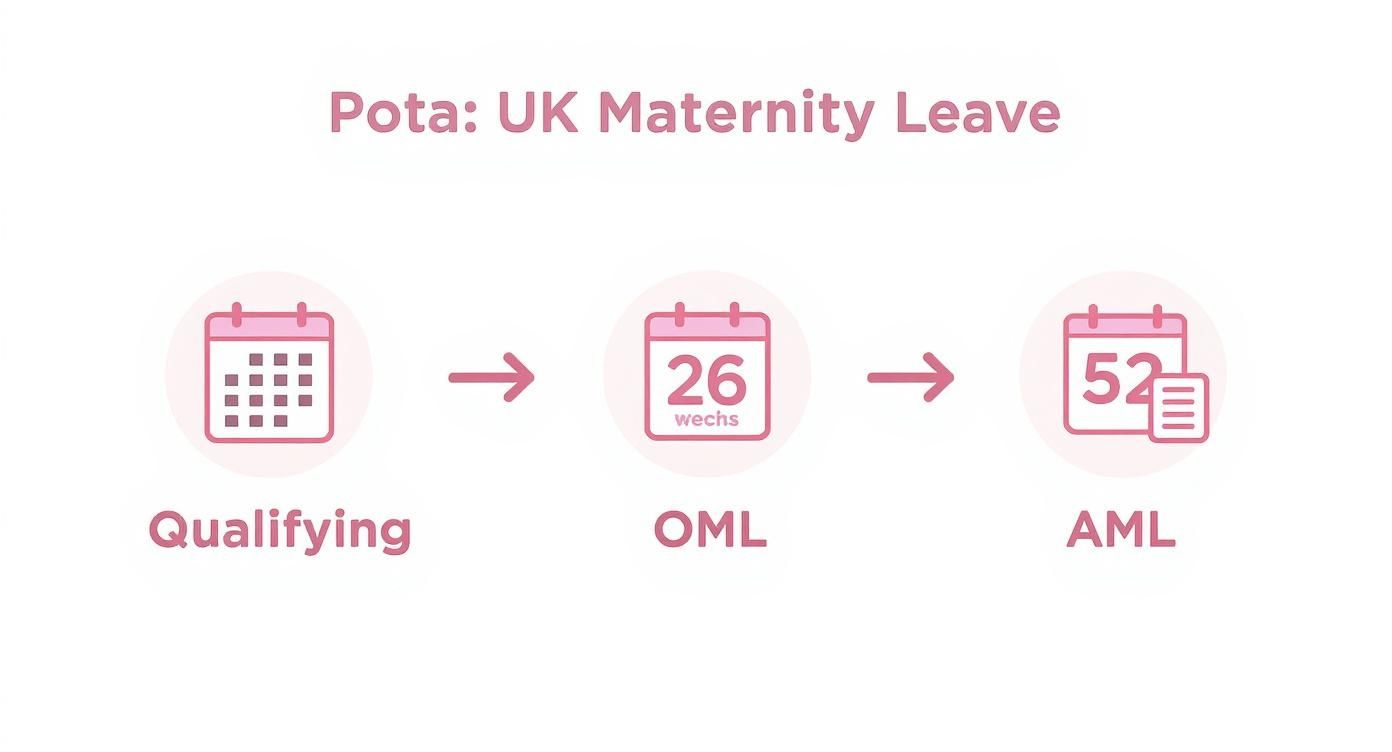
As the flowchart shows, an employee first meets the eligibility criteria before moving through the Ordinary (OML) and then potentially the Additional (AML) phases of their leave.
Putting It All Together: A Real-World Example
Let's see how this works in practice. We'll use an example of an employee named Sarah who earns £35,000 a year.
First, we need her average weekly earnings.
- £35,000 a year ÷ 52 weeks = £673.08 average weekly pay.
Now, we can apply the two SMP rates to Sarah's earnings to see what her weekly pay will look like throughout her leave.
| Leave Period | Calculation | Weekly Pay Received |
|---|---|---|
| Weeks 1-6 | 90% of £673.08 | £605.77 |
| Weeks 7-39 | The lower of £184.03 or 90% of her earnings | £184.03 |
| Weeks 40-52 | Unpaid (if she takes the full 52 weeks) | £0.00 |
You can see from Sarah's example just how significant the drop in income is after that initial six-week period. By running these numbers yourself or using a reliable maternity leave calculator, you can map out a clear budget and plan your finances properly. It’s the best way to make sure you're prepared for the financial changes ahead, with no nasty surprises.
Getting the Most from a Maternity Leave Calculator
While you can absolutely work all this out with a pen and paper, a dedicated maternity leave calculator is a lifesaver for getting a quick, accurate forecast. Let's be honest, trying to decode Statutory Maternity Pay (SMP) guidelines can feel like a full-time job. These tools do the heavy lifting for you, turning complex rules into a simple financial plan. It just saves so much time and worry.
To get a genuinely useful result, you’ll want to have a few key details ready before you start. A little bit of prep makes the whole process smoother and ensures the numbers you get back actually reflect your personal situation.
What You'll Need to Hand
Before you dive in, grab the following information:
- Your Baby's Due Date: This is the cornerstone of everything. It's what sets your 'qualifying week' and kicks off the entire timeline.
- Your Start Date at Work: This is to check you meet the 26-week continuous employment rule.
- Your Average Weekly Earnings: You'll need your gross pay (that’s before tax) for the eight-week 'relevant period' just before your qualifying week. Most payslips will have this info.
- Your Planned Leave Start Date: Think about when you want your leave and pay to officially begin. The earliest you can start is 11 weeks before your due date.
A great, reliable place to begin is the official calculator on the GOV.UK website.
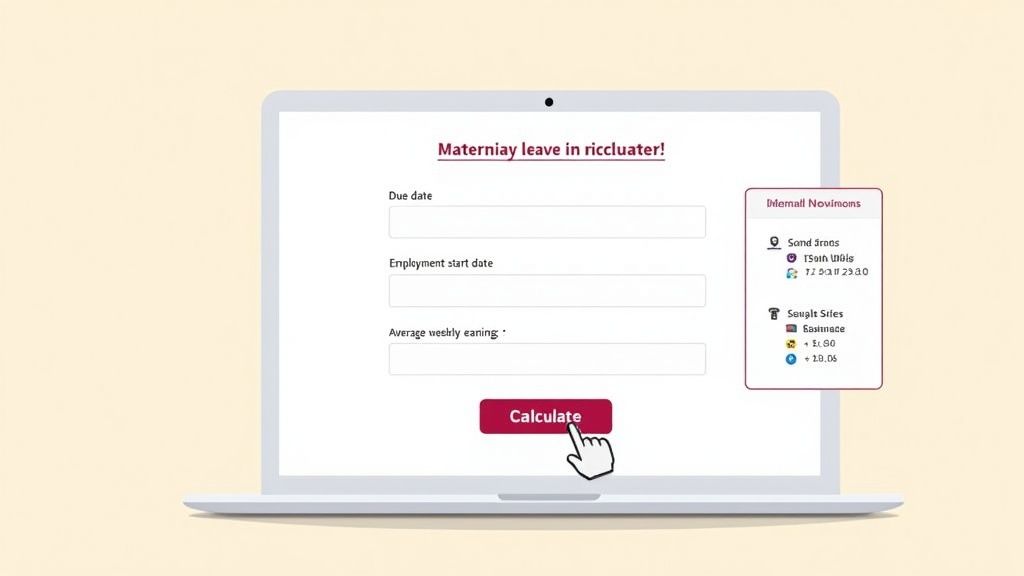
As you can see, the government's own tool asks straightforward questions to figure out your eligibility and map out your payments. Pop in your details, and it will generate a clear breakdown of what you can expect to receive.
Making Sense of the Results
The calculator will typically give you a week-by-week payment schedule. You’ll see the first six weeks paid at 90% of your average earnings, and then the big shift down to the standard statutory rate for the next 33 weeks. Seeing this written down really helps you prepare for that drop in income.
The key number you're looking for is the total estimated SMP you’ll receive over the entire 39 weeks. This figure is the bedrock of your maternity leave budget. It’s what allows you to plan savings, manage your outgoings, and feel in control.
A Practical Tip: Don't be afraid to play around with the numbers. I often advise people to use the calculator to model a few different scenarios. See what happens if you start your leave a week or two later. It might mean more time at home once the baby has arrived, and visualising the financial impact can make that decision much clearer.
And don't forget—you still build up your paid holiday allowance while you're on maternity leave. It's a fantastic perk that's easy to overlook. Think about how you’ll use it. Will you tag it onto the end of your maternity leave for some extra family time, or take it later once you’re back at work? If you're not sure how much you'll have, our UK holiday entitlement calculator guide can help you figure it out, ensuring you get every single day you're entitled to.
Looking Beyond the Statutory Minimum
Statutory Maternity Pay (SMP) is the legal baseline, but for many, it's just the starting point. Forward-thinking employers often offer their own ‘enhanced’ or ‘contractual’ maternity packages as a way to attract and retain great people. This means your financial picture could look much healthier than what a standard maternity leave calculator might predict.
The first place you should always look is your employment contract or the company handbook. These documents are your go-to source for planning your leave. Hunt for a section on family-friendly policies or maternity benefits; that’s where you’ll find the specifics of any enhanced pay your company offers.
What is Enhanced Maternity Pay?
Enhanced packages can vary dramatically from one company to another, but they often include a period of full or half pay, which can make a huge difference to your family's finances.
- Full Pay: Some of the best packages offer full pay for a set number of weeks, often somewhere between six and 26. This is a massive step up from the initial statutory rate of 90%.
- Half Pay: It's also common for employers to offer a number of weeks at 50% of your normal salary, usually after a period of full pay, before you move onto the standard SMP rate.
- Bonus Schemes: Less common, but still out there, are return-to-work bonuses offered as an extra incentive to come back after your leave.
While the UK government's commitment to SMP is significant, with spending projected to hit around £3 billion in 2024/25, these enhanced schemes are funded entirely by your employer. It’s a clear sign of how much they invest in their staff. You can see more details on the government's spending in this Statista report on statutory maternity pay expenditure.
Other Key Benefits to Keep in Mind
Beyond your pay packet, other crucial benefits continue while you're on leave. These are just as important for your financial and professional wellbeing, so don't overlook them.
One of the best perks is that your annual leave continues to build up throughout your entire maternity leave—yes, even during the unpaid part. This means you’ll return to a healthy bank of holiday days. Many new parents use this accrued leave to create a phased, gentler return to work or simply to extend their time off with their new baby. For a refresher on other leave types, our guide covers 7 essential types of leave in the UK for 2025.
Your pension is another massive one.
Your employer is legally required to continue paying their pension contributions based on your normal, full salary for the entire duration of your paid maternity leave (which can be up to 39 weeks). Your own contributions will be calculated based on the actual maternity pay you receive.
Finally, you have the option to use up to 10 'Keeping in Touch' (KIT) days. These days allow you to do some work without bringing your maternity leave or pay to an end. They're completely optional and have to be agreed upon with your employer, but they can be a fantastic way to stay connected, attend important training, or just ease your transition back into the workplace when the time comes.
Planning Your Return and Exploring Shared Leave
Thinking about returning to work can feel like a lifetime away when you're preparing for a new baby, but a bit of foresight now can make the transition back a whole lot easier down the line. While your new arrival is obviously the priority, getting a handle on your options keeps you in the driver's seat of your career and finances.
It’s always a good idea to keep the lines of communication open with your employer. You don’t have to lock in a return date until you give your formal eight weeks' notice, but keeping your manager in the loop is helpful for everyone. This is also the perfect time to start thinking about flexible working arrangements, which you have a legal right to request.

Introducing Shared Parental Leave
Beyond your standard maternity leave, there’s another brilliant option on the table: Shared Parental Leave (SPL). This is a really flexible system that lets you share up to 50 weeks of leave and 37 weeks of pay with your partner, giving you both far more choice in how you care for your child during that crucial first year.
Instead of one parent taking the full time off, you could decide to take leave together or tag-team in blocks. For instance, you could take the first six months and your partner could take the next six. To qualify, both parents need to tick certain boxes related to their work and earnings, so it’s worth checking your employment history and income levels.
Shared Parental Leave is a fantastic way to balance caregiving responsibilities. It empowers partners to be more involved and can be beneficial for the mother's career progression by enabling an earlier return to work if desired.
Despite its benefits, the uptake of parental leave by fathers remains surprisingly low. In fact, 2024 data reveals that UK fathers took an average of just 8.2 days of paternity leave. You can dig deeper into these trends by reviewing the latest annual leave statistics.
How Does SPL Work in Practice?
The beauty of SPL is that you and your partner can decide how to carve up the leave entitlement. You can take it in up to three separate blocks, which is great for a staggered return to work or for planning periods where you're both at home.
The key is to understand the rules, as you have to give your employer proper notice to opt into the scheme. For a really clear breakdown of the process, have a look at our practical guide to Shared Parental Leave.
Got Questions About Maternity Pay and Leave? Let's Clear Things Up
Even with the best planning, you’re bound to have questions. The rules around maternity leave can feel a bit like a maze, especially when your own situation doesn't quite match the textbook examples.
Let’s tackle some of the most common queries that come up.
"What If I Decide Not to Return to Work? Do I Have to Pay Anything Back?"
This is a big one, and there's a crucial distinction to make between statutory pay and any extra pay your company offers.
First, let's talk about Statutory Maternity Pay (SMP). This is the government-mandated minimum. The good news? You are not required to pay back a single penny of your SMP, even if you decide not to go back to your job. It's your legal entitlement.
However, the story can be different for any enhanced or contractual maternity pay.
The Catch with Enhanced Maternity Pay
Many employers offer more generous maternity packages, paying more than the statutory minimum. It's a fantastic perk, but it often comes with strings attached.
Most company maternity policies include a "clawback" clause. This means you might have to repay the extra amount (everything above the SMP level) if you don't return to work for a certain period. This is completely legal and a standard practice.
Before you go on leave, dig out your employment contract and find the maternity policy. Look for the specifics—it will usually state that you need to return for a set period, often between three and six months, to avoid having to pay back the enhanced portion.
It's so important to get your head around this before you finish up. If there’s even a small chance you might not return, you need to budget for this potential repayment. A maternity leave calculator can be really useful here, as it helps you see exactly what's statutory versus what's a company benefit.
"How Do Bank Holidays and Sickness Work?"
Another area of confusion is what happens to your other entitlements while you're off.
Let's start with bank holidays. You continue to accrue them as normal throughout your entire maternity leave. Your employer can’t just ignore them. They’ll usually handle it in one of two ways: either you’ll get the days added to your annual leave to take at another time, or they'll pay you for them.
And what about sickness? If you're off sick with a pregnancy-related illness in the four weeks leading up to your due date, your maternity leave will typically start automatically. If you're unwell for a reason that's not related to your pregnancy, your standard company sick pay policy applies right up until the date you’ve planned for your maternity leave to begin.
Getting a handle on these details means fewer surprises down the line, so you can focus on what’s really important.
Planning leave doesn't have to be a headache. With Annual Leave Tracker, you can see maternity, paternity, and annual leave all in one place, making everything crystal clear for the whole team. Get started with Annual Leave Tracker and take the complexity out of absence management.
Ready to Transform Your Leave Management?
Join 500+ companies using Annual Leave Tracker to streamline their HR processes.
Related Articles

How to Calculate Pro Rata Holidays A Simple UK Guide
Working out pro rata holidays is actually quite straightforward. At its core, it's just about making...
September 24, 2025
How to Calculate Annual Leave Entitlement: UK Guide
Figuring out annual leave entitlement doesn't have to be complicated. The basic formula is simple:...
September 24, 2025
HR Systems for Small Business A Complete Guide
Trying to run a small business using spreadsheets and a jumble of different documents is a bit like...
September 25, 2025