 Annual Leave Tracker
UK Holiday Entitlement Calculator Guide

While a quick UK holiday entitlement calculator is a handy tool, it’s always a good idea to understand the rules that sit behind the numbers. The law is clear: nearly all workers in the UK are entitled to a minimum of 5.6 weeks of paid holiday each year.
For most people working a typical full-time week, this comes out to 28 days, which can include bank holidays.
Understanding Your Core Holiday Rights
Before you start crunching numbers, it's worth getting a firm grasp on the fundamentals of UK annual leave. This basic knowledge is the foundation for figuring out what you’re owed, whether you’re full-time, part-time, or work irregular hours. Without this context, any calculator is just a black box spitting out a figure.
This infographic gives a great visual breakdown of a standard full-time entitlement, showing how those 28 days build up over the year.
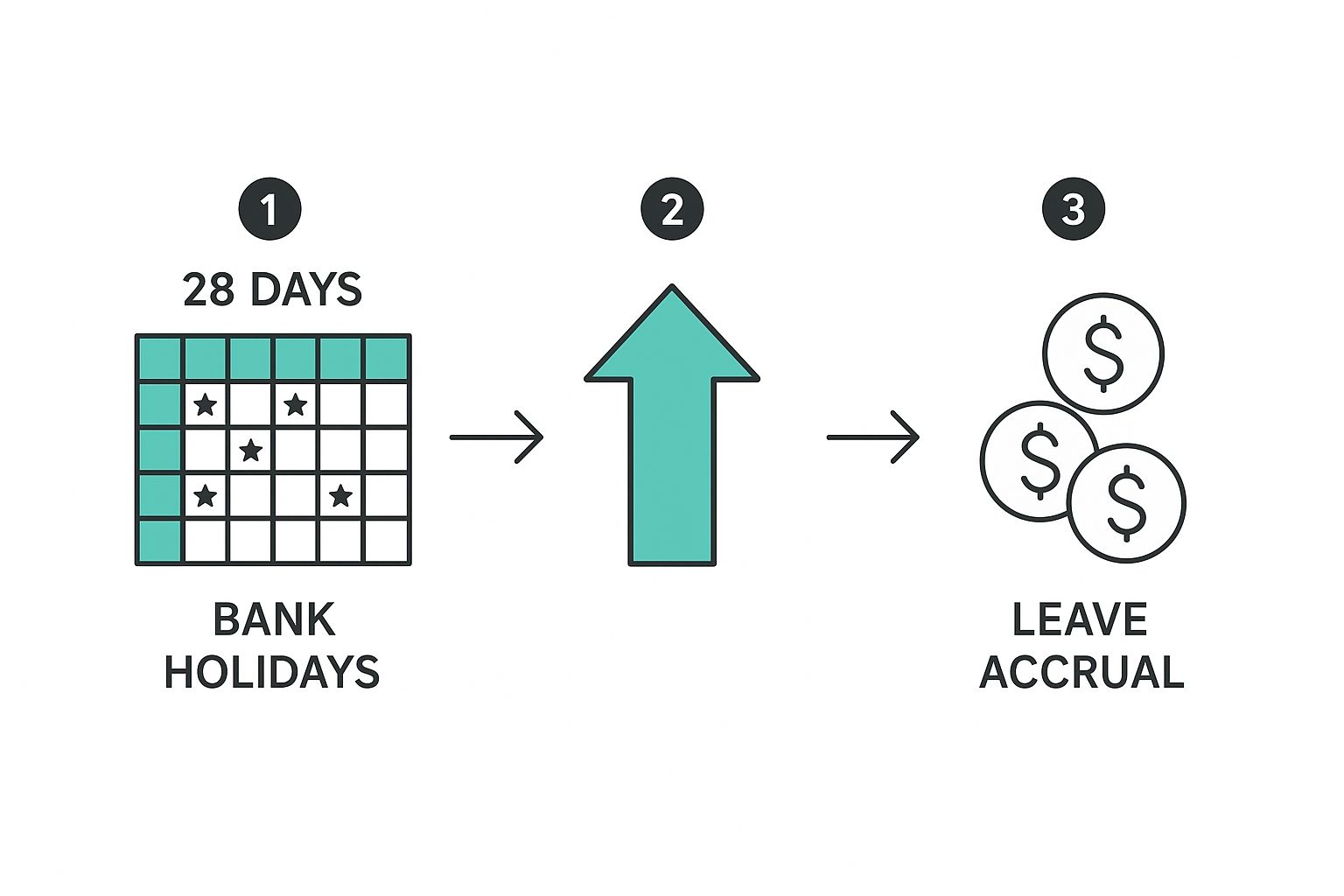
As you can see, holiday entitlement doesn't just land in your lap on day one. It's earned month by month.
The Basics of Statutory Leave
In the UK, the law guarantees a minimum of 5.6 weeks of paid annual leave. This is a legal right designed to make sure everyone gets enough time to rest and recharge.
For someone on a standard five-day week, this works out neatly to 28 days. This total is actually a combination of two different allowances: a minimum of four weeks (20 days) derived from EU law, plus an extra 1.6 weeks (8 days) under UK law, which often covers the bank holidays. If you want to dig deeper into the legal side of things, you can explore our detailed guide on what statutory annual leave means.
One of the most important things to remember is that this is the legal floor, not the ceiling. Many employers offer more generous leave policies as part of their benefits package, but they can never legally offer less than the statutory minimum.
Here’s a quick look at how the statutory minimum translates based on the number of days you work.
Statutory Minimum Holiday Entitlement At a Glance
| Days Worked Per Week | Statutory Weeks | Equivalent Days of Leave |
|---|---|---|
| 5 | 5.6 | 28 |
| 4 | 5.6 | 22.4 |
| 3 | 5.6 | 16.8 |
| 2 | 5.6 | 11.2 |
| 1 | 5.6 | 5.6 |
As the table shows, the 5.6 weeks is the constant factor. Your final entitlement in days is simply that number multiplied by how many days you typically work each week.
How Your Holiday Entitlement Accrues
Your holiday allowance doesn't appear in full on your first day of a new job. Instead, it ‘accrues’, which is just a formal way of saying it builds up as you work. The standard way this happens is at a rate of one-twelfth of your annual total for each month you're on the payroll.
This system keeps things fair, especially for people who start or leave a job part-way through the company’s leave year.
For example, a full-time employee will have earned about 7 days of holiday after working for three months (which is 28 days / 12 months * 3 months). This progressive build-up is the core principle behind how any UK holiday entitlement calculator works.
Calculating Holiday Pay for Full-Time and Part-Time Staff
Knowing the basic rules for holiday entitlement is a good start, but the real challenge often lies in applying them to different working patterns. A full-time employee’s calculation is usually a piece of cake. But when it comes to part-time staff, you need a slightly different approach to make sure everything is fair, square, and legally sound.
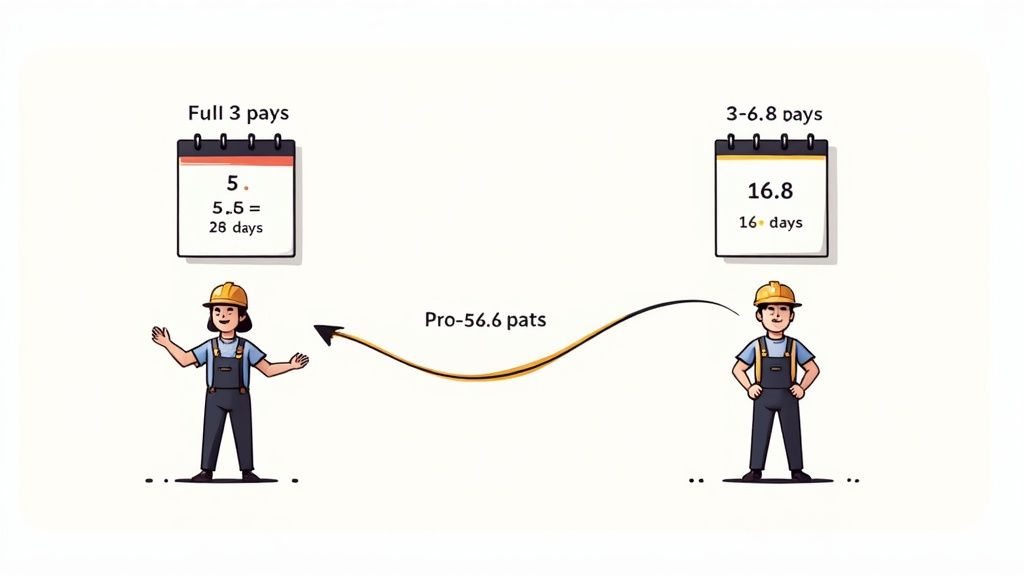
Let's walk through the maths for both, with some clear examples to take the guesswork out of it.
The Full-Time Calculation
For a typical full-time employee who works five days a week, the maths is wonderfully simple. They get the statutory minimum of 5.6 weeks of paid time off.
To work that out in days, you just multiply the weeks by the days they work:
5.6 weeks x 5 days = 28 days of paid holiday per year.
This 28-day figure is the standard baseline that most employers work with. It's important to remember that this allowance can include bank holidays, but that should always be clarified in the employment contract.
The Part-Time Pro-Rata Method
For your part-time team members, you'll need to calculate their holiday on a pro-rata basis. This is just a fair way of ensuring their allowance is proportional to what a full-time colleague receives. You still start with the same magic number: 5.6 weeks.
Let's imagine you have an employee, Sarah, who works a steady three days a week. We use the same formula, just swapping in her specific working pattern:
5.6 weeks x 3 days = 16.8 days of paid holiday per year.
In practice, it’s much tidier to round this up to the nearest half or full day. So, Sarah would get 17 days of leave. If you want to dive deeper into this, we have a complete guide to calculating pro-rata holiday entitlement.
The crucial thing to remember is that part-time workers are legally protected from being treated less favourably than full-timers. The pro-rata system is how you ensure their holiday entitlement perfectly reflects that principle.
This method works for anyone on a regular contract, even if their days vary. For example, if David works two days one week and four the next, you'd look at his contracted average. If his contract states he works an average of three days per week, his calculation is exactly the same as Sarah’s.
Handling Bank Holidays for Part-Time Staff
Bank holidays can be a real headache for part-time staff, especially when one falls on a day they don't normally work. The simplest and fairest way to manage this is to give them their full pro-rata entitlement and let them book bank holidays off from that total, just like any other day off.
Let's stick with Sarah's example:
- Her total entitlement: She has 16.8 days of holiday for the year.
- A bank holiday Monday comes up: Sarah doesn’t work Mondays, so she doesn't lose out. Her entitlement is unaffected.
- Another bank holiday falls on a Friday: This is one of her normal working days. She simply books it off using one of her 16.8 days of leave.
This approach ensures everyone gets their full, proportional holiday allowance, no matter which days of the week they happen to work. Using a reliable UK holiday entitlement calculator can automate all these sums for you and help avoid any tricky errors.
Getting Holiday Pay Right for Irregular and Zero-Hours Contracts
Figuring out holiday entitlement for staff on zero-hours contracts or with unpredictable working patterns used to be a real headache for employers. Their hours can fluctuate so much week-to-week that the usual pro-rata calculation just doesn't work. Thankfully, we now have a clear, standardised approach that ensures everyone gets what they're owed.
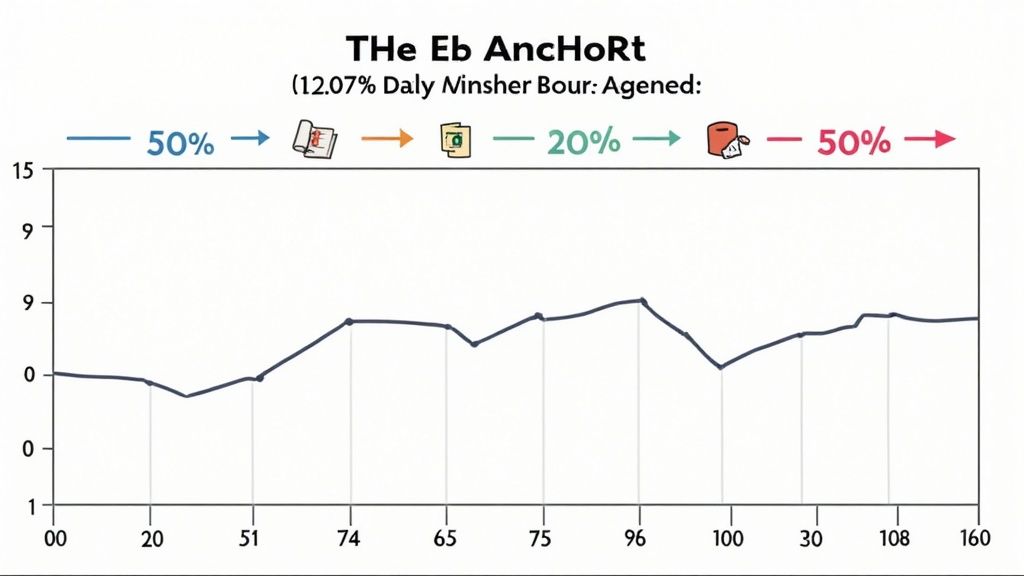
The trick is to stop thinking in terms of days and start focusing on the actual hours they've worked. It's a far more accurate and fair reflection of their contribution.
The 12.07 Percent Method Explained
The simplest and most accepted way to handle this is by using the 12.07% accrual method. That number isn't just pulled out of thin air; it comes directly from the statutory holiday rules.
Here’s the logic behind it:
- A standard working year is 52 weeks long.
- By law, workers get 5.6 weeks of paid leave.
- This means people are actively working for 46.4 weeks of the year (52 weeks - 5.6 weeks).
So, if you work out what percentage 5.6 weeks is of the 46.4 working weeks, you land on 12.07%. This means for every single hour an employee works, they earn or "accrue" holiday time at this rate.
Key Takeaway: The 12.07% rule makes sure a worker’s holiday entitlement is directly tied to the hours they've actually put in. It’s the fairest system there is for fluctuating work schedules.
Let's put this into practice. Imagine Alex, who works in a gift shop and picks up a lot of extra shifts over Christmas. In a busy December, he works a total of 80 hours.
To calculate his holiday entitlement for that month, the calculation is simple:
80 hours worked x 12.07% = 9.656 hours of holiday accrued.
This gives Alex a precise amount of paid leave he's earned, which can then be tracked for him to use later. For a deeper dive into the rules, our guide on understanding holiday entitlement on a zero-hour contract has all the details.
Recent Changes and Rolled-Up Holiday Pay
It’s worth noting that the landscape for irregular hours workers has recently been clarified. Legislative reforms that kicked in from April 2024 have really firmed up how holiday pay is calculated for these roles. The new rules officially endorse the 12.07% calculation, clearing up a lot of past confusion.
One of the biggest developments is the return of rolled-up holiday pay as a legitimate option, but only for these specific workers. This is where you add an amount for holiday pay directly onto their regular wages, rather than paying them when they actually take time off.
While it can simplify payroll, you have to be careful. The holiday pay portion must be clearly itemised on their payslip. It's a practical solution, but employers need to make sure they're implementing it correctly to stay compliant.
Using an Online Calculator for Fast and Accurate Results
While it's good to understand the maths behind holiday pay, let's be realistic. For a quick, precise figure, nothing beats a good online UK holiday entitlement calculator. It’s the simplest way to sidestep any potential miscalculations.
Think of these tools as a shortcut to the right answer, but remember the old saying: garbage in, garbage out. The figure you get is only as reliable as the information you put in.
What You Need Before You Start
To get a result you can count on, you’ll need a few bits of information about your working life. It's best to have these ready before you open the calculator.
- Your work pattern: Do you work the same days every week? The calculator needs to know if you're on a standard five-day week, a set part-time schedule, or if your hours and days change.
- Your contract type: Are you full-time, part-time, on a zero-hours contract, or maybe a shift worker? Each type is handled slightly differently.
- Your leave year: This is the 12-month period your employer uses for holidays. It might be the calendar year (January-December), the financial year (April-March), or it could even run from the anniversary of your start date.
- Employment start or end date: This is essential if you’ve started or are leaving part-way through the company’s leave year. The calculator will need this to work out your pro-rata entitlement.
Getting this info together first makes the whole process much smoother.
Making Sense of the Results
Once you’ve plugged in your details, the calculator will give you a final number, usually shown in days or hours. If the figure isn't what you expected, don't worry – there’s usually a simple explanation.
For example, if the number seems a bit low, double-check that you entered the right leave year details. A common slip-up is forgetting to input a mid-year start date, which naturally means you'll get a pro-rata figure instead of the full annual amount.
Pro Tip: Always check the calculator's result against your employment contract. Your company might offer a more generous holiday allowance than the legal minimum, which would explain any difference you see.
Ultimately, these calculators are brilliant for taking the headache out of a tricky part of employment law. With accurate information, you get a dependable answer in seconds, freeing you up from wrestling with spreadsheets and percentages.
What Happens to Holiday When Life Gets in the Way?
Holiday calculations seem simple enough on paper, but real life rarely is. What happens when an employee is on long-term sick leave, goes on maternity leave, or decides to leave the company? These situations can easily trip up even experienced managers, so knowing how to handle them is vital for keeping everything fair and compliant.
The main thing to remember is this: an employee's statutory holiday entitlement keeps building up even when they aren't physically at work. As long as their employment contract is active, their right to paid time off is too.
Sick Leave, Maternity Leave, and Holiday Accrual
If someone is on long-term sick leave, or taking maternity, paternity, or adoption leave, their holiday allowance accrues just as if they were working every day. This is a crucial legal protection to ensure people aren’t penalised for taking time off for their health or to care for their family.
This can create a practical headache, though. An employee might come back to work with a huge bank of holiday time waiting for them.
- During Sick Leave: An employee can opt to take their paid holiday while they're off sick, but you absolutely cannot force them to. It’s their choice.
- During Parental Leave: From experience, it’s often much simpler if employees use up any outstanding holiday before their parental leave starts. Trying to squeeze it all in after they return can be a real challenge for everyone.
- Carrying Over Leave: If they genuinely couldn't use their holiday because they were on sick or parental leave, they have the right to carry it over into the next leave year.
It's a common mistake to think holiday accrual simply pauses. The employment relationship hasn't ended, so the right to paid leave continues. Clear, open communication is your best tool here to plan for how and when they'll take this built-up leave.
Carrying Unused Holiday Days into the Next Year
Normally, the rule for annual leave is "use it or lose it". But there are important exceptions. If an employee was unable to take their holiday because they were on sick leave, they must be allowed to carry over a maximum of 1.6 weeks into the next leave year. For someone working full-time, that’s 8 days.
It’s also interesting to see how many people don’t use their full allowance anyway. A recent analysis found that the average UK employee took 33.9 days off in 2023. That figure has actually dropped by nearly 12% since 2020. With many people carrying over an average of five unused days each year, it’s a clear sign that we need to actively encourage our teams to take the breaks they're entitled to. You can dig into these trends in the full UK annual leave report.
Calculating Final Holiday Pay When Someone Leaves
When an employee hands in their notice, one of the final pieces of admin is to sort out their remaining holiday. You are legally required to pay them for any statutory holiday they’ve accrued but haven't taken. This is often referred to as 'payment in lieu of holiday'.
The calculation is all about prorating their entitlement based on how much of the leave year they’ve worked. For instance, if someone leaves exactly halfway through the year, they’re entitled to half of their total annual leave. You just subtract any holiday they’ve already taken, and the rest gets paid out in their final paycheque. This is one of those critical final steps where a good uk holiday entitlement calculator can be a real lifesaver, ensuring you get the numbers spot on.
Employee leave isn't always straightforward, and different situations have different rules. Here's a quick reference table to help clarify how holiday entitlement is affected during various types of absence.
Handling Leave in Different Circumstances
| Leave Type | How Holiday Entitlement Accrues | Key Consideration |
|---|---|---|
| Sick Leave | Continues to accrue as normal throughout the absence. | Unused holiday can be carried over if the employee was too unwell to take it. |
| Maternity/Paternity Leave | Accrues at the normal rate for the entire leave period. | Best practice is to encourage staff to use leave before their parental leave starts. |
| Adoption/Shared Parental Leave | Continues to accrue throughout the leave, just like other parental leave. | Communication is key to managing the build-up and planning its use upon return. |
| Unpaid/Sabbatical Leave | Accrual depends on what's written in the employment contract. | The contract must be clear on whether holiday accrues during unpaid leave. |
Understanding these nuances ensures that you’re not only compliant with UK law but also treating your employees fairly during what can often be challenging times in their lives.
Your Top UK Holiday Pay Questions Answered
Even with a reliable calculator on hand, some tricky situations around holiday pay always seem to crop up. I've seen these same questions countless times, so let's walk through the common sticking points that calculators don't always explain.
Can My Employer Tell Me When to Take My Holiday?
In short, yes, they can. It might not always feel fair, but your employer has the right to dictate when you take your annual leave. This is a pretty standard practice in sectors like manufacturing, where the entire business might shut down for a couple of weeks over the summer or Christmas.
The crucial part is that they have to give you proper notice. The legal requirement is that the notice must be at least double the length of the leave they're asking you to take. So, if they need you to take one week off, they must tell you at least two weeks beforehand.
What's the Difference Between Statutory and Contractual Holiday?
This is a really important one to get your head around, as it defines the minimum you must provide versus what you offer as a company perk.
-
Statutory Holiday: This is the legal minimum everyone gets – 5.6 weeks a year. You can't offer less than this, period. For a full-timer, this works out to 28 days.
-
Contractual Holiday: This is any extra leave your company offers on top of the statutory amount. For instance, if your contract gives an employee 33 days of leave, 28 of those are statutory, and the remaining 5 are a contractual benefit.
A key takeaway: When an employee leaves, you are legally obligated to pay them for any statutory holiday they haven't taken. Whether you pay out the extra contractual days depends entirely on what's written in their employment contract. Always check the contract.
How Do I Handle Leave for Workers on Variable Shifts?
Calculating holiday entitlement in days for people on zero-hours contracts or with ever-changing shift patterns is a recipe for a headache. It's just not practical. The best approach here is to start thinking in hours.
The most common and accepted method is to use the 12.07% accrual rate. Essentially, for every hour an employee works, they earn holiday time equivalent to 12.07% of that hour. This system is fair because their holiday entitlement is perfectly aligned with the actual hours they’ve put in.
A good UK holiday entitlement calculator built for hourly work can handle all this for you. It takes the guesswork out of the equation and gives you a clear, compliant record for both you and your employee.
Managing leave shouldn't be a chore. Annual Leave Tracker provides clean, simple software that automates accruals, simplifies requests, and keeps everyone in the loop. Find out how we can help your business at https://www.annualleavetracker.com.
Ready to Transform Your Leave Management?
Join 500+ companies using Annual Leave Tracker to streamline their HR processes.
Related Articles

How to Calculate Pro Rata Holidays A Simple UK Guide
Working out pro rata holidays is actually quite straightforward. At its core, it's just about making...
September 24, 2025
How to Calculate Annual Leave Entitlement: UK Guide
Figuring out annual leave entitlement doesn't have to be complicated. The basic formula is simple:...
September 24, 2025
HR Systems for Small Business A Complete Guide
Trying to run a small business using spreadsheets and a jumble of different documents is a bit like...
September 25, 2025